

A Road Trip Through Tuscany’s Backroads: Where the Map Ends and Italy Begins

Some journeys start with a destination. Others start with a question. That morning in Siena, my only plan was simple: no highways, no rush, no strict schedule. Just a car, a full tank, and a network of thin white roads disappearing into the hills. The GPS suggested the fastest route, as it always does, calculating time and distance with mechanical precision. I ignored it. Instead, I turned onto a narrow road marked only by a small sign: Strada Provinciale. That was the real beginning of the journey.
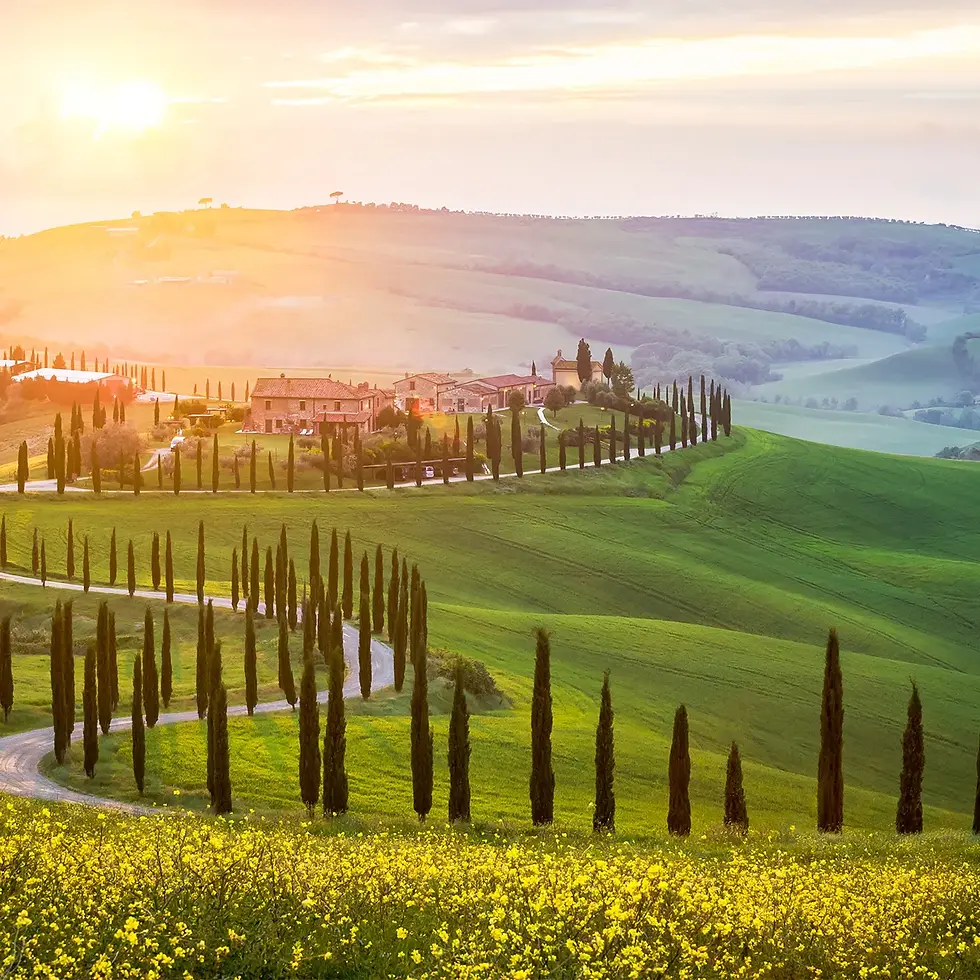
I left early, when cafés were still setting up their terraces and the streets were quiet, when the city was waking up slowly and tourists had not yet filled the squares. The air was fresh, and the light soft. As soon as I left the main road, the landscape began to change. The asphalt slowly gave way to gravel. Vineyards followed olive groves, olive groves gave way to wide fields of wheat moving gently with the wind. Every curve revealed a new postcard: stone farmhouses resting on hilltops, lonely cypress trees standing like sentinels, distant bell towers emerging from the mist. There were no billboards, no souvenir shops, no signs telling me what I should see or buy. Just space, silence, and time. I drove with the window open, listening to the countryside, feeling that rare sensation of being exactly where I was supposed to be.
Around noon, hunger and curiosity led me to stop in a tiny village I had never heard of. It was not marked on any tourist guide. One bar, one square, a small church, and five old men playing cards under the shade of a tree. I parked near the piazza and ordered an espresso. The owner, probably in his seventies, served it without hurry, as if time followed different rules there. He asked me where I was going. “Nowhere in particular,” I replied, half joking, half serious. He smiled. “That’s the best destination,” he said. We talked for ten minutes about tourists, about seasons, about how the village fills up in August and empties in winter, about how young people leave and sometimes return. Before I left, he pointed toward the hills behind the square. “Go that way,” he suggested. “You’ll like it.”
I followed his advice. Ten minutes later, the road ended. Literally. No signs, no asphalt, no indication that this was still a public road. Just dirt, grass, and a narrow track disappearing into the countryside. I stopped, unsure whether to turn back. Part of me thought it was a mistake, that I had gone too far. Then I noticed a farmhouse in the distance, surrounded by vineyards. Curiosity won. I kept going, slowly, carefully, trusting instinct more than technology. Sometimes the best routes are not on any map.
Behind that farmhouse, almost hidden by trees, I discovered a small family-run winery. There was no parking lot, no shop window, no tour buses waiting outside. Just a couple working among wooden barrels and stainless-steel tanks. They looked surprised to see me, but they welcomed me in with natural kindness. We spoke in a mixture of Italian and gestures. They offered me a glass of their wine. I tasted it standing on a wooden crate, looking at vineyards stretching to the horizon, feeling the warmth of the afternoon sun on my face. No reservation, no guided tour, no schedule. Just presence. Just reality.
I arrived at my hotel late that evening, tired, dusty, and smiling. That day I had driven less than 120 kilometers, a distance that on a highway would take little more than an hour. Yet I felt I had traveled much farther. Through conversations, through landscapes, through moments that cannot be planned or replicated. Through small encounters that leave a quiet mark. Many of these places are not famous landmarks, yet they belong to a wider cultural landscape that makes Italy unique, with several areas recognized among the country’s UNESCO World Heritage Sites.
Italy reveals itself like this. Not when you try to conquer it, tick boxes, and collect photos, but when you let it guide you. When you accept detours, delays, and imperfections. When you understand that travel is not about controlling time, but about giving time space to happen. Road trips, especially on secondary roads, teach you patience, attention, and humility. (If you love this way of traveling, you may also enjoy my guide to Italy beyond the cities and its slow travel routes through countryside and small roads, where I explore other hidden paths across the country.)
If you are reading this, perhaps you are already dreaming about your next trip. Maybe you are planning routes, checking maps, comparing distances. My suggestion is simple: plan enough to feel safe, then leave space for uncertainty. Leave room for cafés without names, roads without numbers, and villages without reviews. Those are often the places that stay with you the longest.
Sometimes, the real destination is simply learning to get lost — in the right way.
Road Trip Ideas in Italy: Routes to Inspire Your Next Journey
If this story has sparked your curiosity, here are some road trip ideas across Italy that follow the same spirit of slow travel, secondary roads, and unexpected discoveries.
1. Tuscany’s Hidden Hills
Route idea: Siena → Asciano → Monte Oliveto Maggiore → Pienza → Val d’Orcia backroadsPerfect for: vineyards, monasteries, rolling landscapes, small wineriesBest time: April–June, September–October
2. Emilia-Romagna Between Apennines and Villages
Route idea: Bologna → Brisighella → Marradi → Palazzuolo sul Senio → ModiglianaPerfect for: mountain roads, medieval towns, local trattoriasBest time: Spring and early autumn
3. Abruzzo’s Wild Heart
Route idea: L’Aquila → Campo Imperatore → Santo Stefano di Sessanio → ScannoPerfect for: dramatic landscapes, silence, stone villagesBest time: June–September
4. Sicily’s Southeast Baroque and Coast
Route idea: Noto → Modica → Ragusa Ibla → Scicli → Punta SeccaPerfect for: baroque towns, coastal roads, food experiencesBest time: April–June, September
5. Puglia’s Countryside and White Towns
Route idea: Ostuni → Martina Franca → Locorotondo → Alberobello → rural masseriePerfect for: olive groves, dry-stone walls, rural hospitalityBest time: May–June, September
These routes are not meant to be followed strictly. Think of them as starting points. The real journey begins when you take a wrong turn, follow a suggestion from a stranger, or decide to stop simply because the view is beautiful.
That is where Italy truly begins.


Comments